Isometric Crystal System | GAI God Me
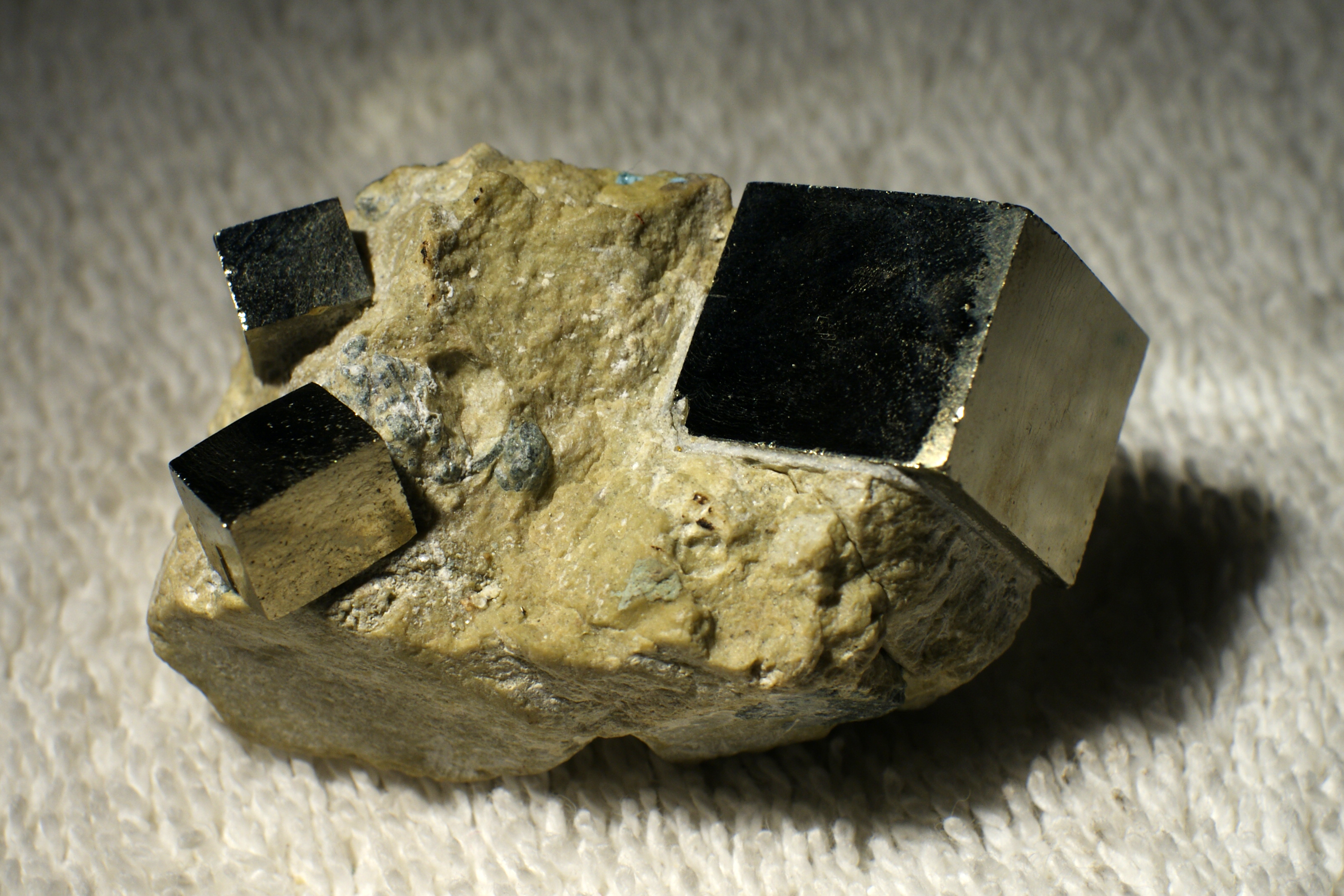
The isometric crystal system, also known as the cubic system, is one of the most fundamental and symmetrical arrangements of atoms found in crystalline…
Contents
Overview
The isometric crystal system is defined by a unit cell that is a cube, meaning its three crystallographic axes (a, b, and c) are equal in length (a=b=c) and intersect at 90-degree angles. This arrangement results in the highest possible symmetry for a crystal lattice, featuring multiple axes of rotation, mirror planes, and inversion centers. The system is further classified into three Bravais lattices: primitive cubic (cP), where lattice points are only at the corners of the cube; body-centered cubic (cI), with an additional lattice point at the center of the cube; and face-centered cubic (cF), with lattice points at the corners and in the center of each face. Each of these lattices can accommodate different atomic arrangements, known as motifs, leading to distinct crystal structures like [[diamond-cubic-structure|diamond cubic]] or [[zincblende-structure|zincblende]]. The symmetry of the unit cell directly influences macroscopic properties such as cleavage, optical behavior, and mechanical strength.
⚙️ How It Works
Approximately 7% of all known minerals crystallize in the isometric system, making it a significant category in mineralogy. Within metals, the body-centered cubic (cI) structure is prevalent in elements like [[iron|iron]] (at room temperature) and [[tungsten|tungsten]]. The face-centered cubic (cF) structure is found in [[copper|copper]], [[aluminum|aluminum]], and [[gold|gold]]. The primitive cubic (cP) structure is less common in elemental solids but is a fundamental building block in understanding more complex lattices. The [[sodium-chloride-structure|sodium chloride]] structure, a common ionic compound, is based on two interpenetrating face-centered cubic lattices.
📊 Key Facts & Numbers
The cubic symmetry of the isometric system has permeated art, architecture, and design for centuries, often associated with perfection, stability, and divine order. The prevalence of cubic structures in metals has also enabled technological advancements, from the construction of early tools from bronze (an [[alloy|alloy]] with a face-centered cubic structure) to the development of high-strength steel alloys based on body-centered cubic iron.
👥 Key People & Organizations
Current research continues to explore novel materials exhibiting isometric structures, particularly in the field of [[semiconductor-physics|semiconductor physics]] and [[nanotechnology|nanotechnology]].
🌍 Cultural Impact & Influence
A persistent debate in crystallography concerns the precise classification and naming conventions for structures derived from the isometric Bravais lattices, especially when complex motifs are involved. The three primary Bravais lattices (cP, cI, cF) are universally accepted. The relationship between macroscopic crystal symmetry and microscopic atomic arrangement is not always straightforward, leading to discussions about how best to represent and teach these concepts to students in introductory materials science courses.
⚡ Current State & Latest Developments
The future outlook for materials based on the isometric crystal system remains exceptionally bright.
🤔 Controversies & Debates
The practical applications of the isometric crystal system are vast and foundational to modern technology. Minerals crystallizing in this system, such as [[diamond|diamond]], are used as abrasives and in jewelry. Metals with cubic structures are ubiquitous: body-centered cubic iron forms the basis of steel, essential for construction and manufacturing, while face-centered cubic copper is the backbone of electrical wiring. In electronics, [[silicon|silicon]] and [[gallium-arsenide|gallium arsenide]] (both with cubic structures) are fundamental to the semiconductor industry, powering everything from smartphones to supercomputers. The isometric structure of [[salt|sodium chloride]] is vital for food preservation and industrial processes.
🔮 Future Outlook & Predictions
The study of the isometric crystal system is deeply intertwined with several other scientific disciplines. Understanding its atomic arrangements is crucial for comprehending [[solid-state-physics|solid-state physics]] and the behavior of electrons in materials. Its geological significance is explored within [[mineralogy|mineralogy]] and [[petrology|petrology]], where crystal habit provides clues to formation conditions. The mathematical principles of symmetry, group theory, and lattice geometry are fundamental to its description, linking it to [[abstract-algebra|abstract algebra]]. For further exploration, one might examine the [[hexagonal-crystal-system|hexagonal crystal system]] for comparison or delve into the specific properties of [[ionic-crystals|ionic crystals]] and [[metallic-bonding|metallic bonds]].
Key Facts
- Category
- science
- Type
- concept